


There is a hard truth at the heart of the global waste management conversation that rarely gets the attention it deserves.
When waste systems fail, the consequences are not abstract nor theoretical. They are borne by people by workers whose bodies absorb the risk long before the rest of society feels any disruption.
The landfill collapse in Binaliw, Cebu City, Philippines, is one such moment. The incident has led to the loss of lives, injuries, and missing individuals, according to local authorities and reporters. Families are still waiting as search, rescue, and retrieval efforts continue.[1]
While investigations into the specific causes are ongoing, what is already clear is this: this tragedy did not happen overnight.
This did not happen overnight
The Binaliw landfill collapse did not come out of nowhere. For nearly a decade, the site had been under scrutiny. It has been flagged for environmental violations, subjected to amended permits, protested by residents, and warned over by officials. [2]
Despite changes in management and promises of improvement, concerns persisted. On January 8, 2026, those unresolved risks became catastrophic, burying workers and facilities beneath debris.
These documented developments matter. They show that this landfill was not a sudden anomaly, but a facility subject to repeated examination and warning. The long arc is important because it reveals how risk can accumulate quietly within systems over time, long before it becomes visible through tragedy.
A global pattern
As painful as it is, the tragedy in Cebu echoes other instances around the world where waste systems have collapsed, quite literally, and the consequences have fallen heaviest on workers and nearby communities.
For example:
- In Sri Lanka in 2017, a massive garbage dump in Meethotamulla collapsed, killing at least 32 people and leaving others missing.[3]
- In Ethiopia in 2017, a gigantic landfill mound at the Koshe dump in Addis Ababa gave way, killing more than 115 people and injuring dozens, many of whom were waste pickers and informal workers living and working at the site.[4]
- In Indonesia in 2005, the Leuwigajah landfill’s collapse after days of rain killed 143 people, including waste workers and scavengers who lived and worked on the slopes of the dumpsite.[5]
Across these contexts, the pattern is painfully consistent: people doing essential work inside systems that could not safely carry the risk placed upon them.
For those of us working in waste and sustainability, this is impossible to ignore. It’s a reminder that waste systems are not just technical or environmental challenges, they are human systems. Any solution that does not account for the safety and dignity of the people inside it is incomplete by design.
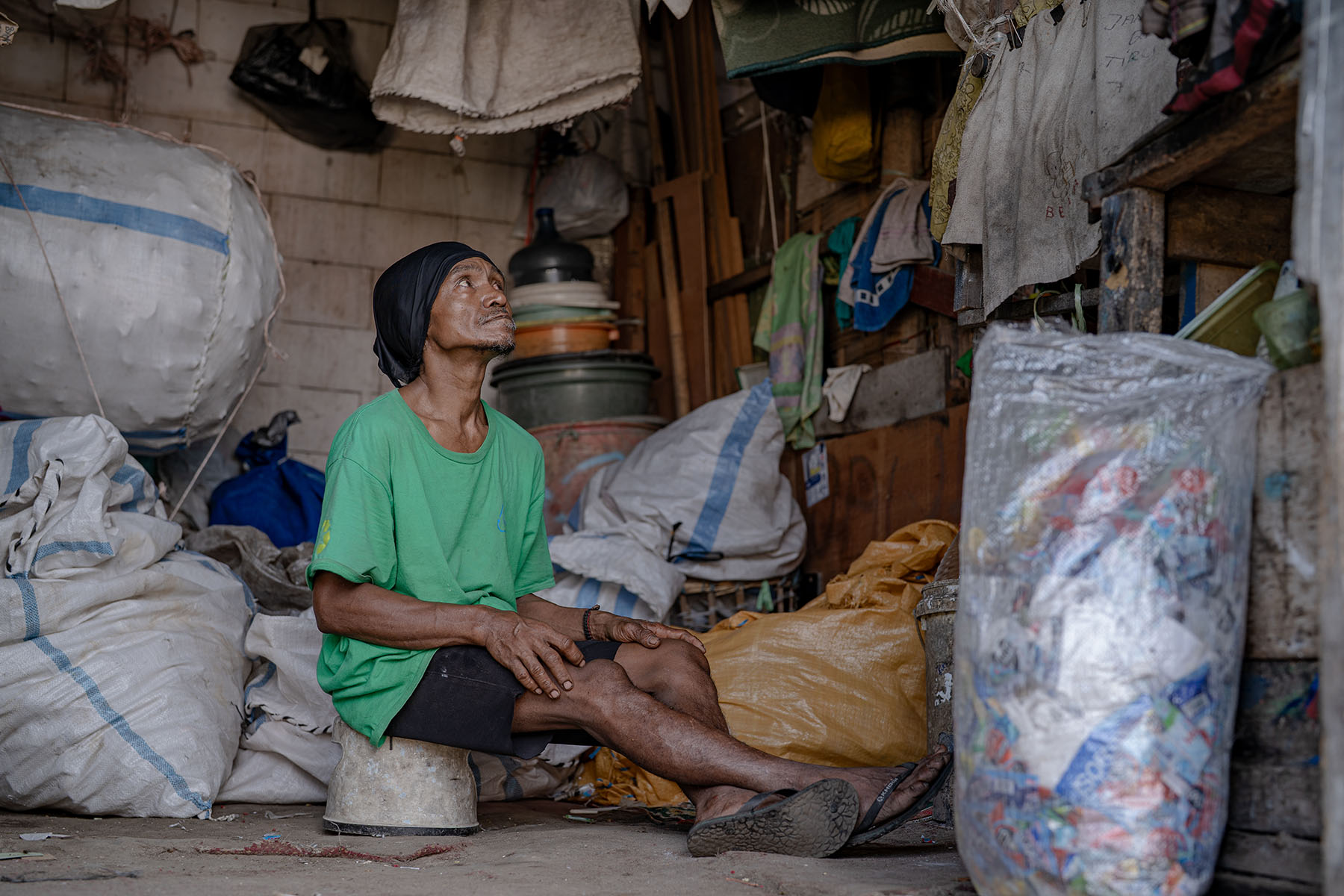
Workers safety cannot be an afterthought
Waste workers do some of the most essential yet under-acknowledged work in modern society. They keep cities clean. They help divert materials from landfill to reuse and recycling streams. They handle what the rest of us discard without a second thought.
Too often, their safety is treated as secondary – something to be addressed later, once systems are already built or once targets are met.
But this moment in Cebu, and similar events elsewhere, shows that safety is not a luxury or an afterthought. It must be a core part of system design, planning, monitoring, and governance.
When safety sits in the margins, risk becomes invisible until it isn’t.
A call to reflect and act
Right now, what matters most is holding space for the workers and families affected in Cebu. For the waiting. For the uncertainty. For the grief that doesn’t resolve when the news cycle moves on.
But holding space cannot be the end of the story.
If this moment is to mean anything, it must push us collectively to rethink how waste systems are built, governed, and scaled. To ask harder questions. To design with care. To refuse solutions that succeed on paper while failing the people inside them.
This responsibility is shared by governments, operators, brands, and all of us who benefit from systems that move waste out of sight but not without consequence.
Let’s remember that when we talk about waste, we are never just talking about materials. We are talking about people. And if we forget that, the cost will continue to be paid by those least able to bear it.
FAQs
Why do landfill collapses continue to occur across different countries?
Landfill collapses are rarely the result of a single failure. They often reflect accumulated risks: poor monitoring, inadequate waste infrastructure, weak enforcement, and governance gaps. All of these go unaddressed until a tipping point is reached.
Who is most at risk when waste management systems fail?
Waste workers, informal recyclers, and nearby communities typically face the greatest danger. These groups often bear the physical risks of waste systems while having the least power to influence how those systems are designed or governed.
What does worker safety mean in the context of waste management?
Worker safety in waste management extends beyond protective equipment. It includes safe site design, risk management, emergency preparedness, fair labour conditions, and accountability mechanisms that prioritise human wellbeing alongside operational performance.
Sources:
- Cherry Ann Virador, Binaliw landfill collapse death toll rises to 8, Sunstar, January 12, 2026, https://www.sunstar.com.ph/cebu/binaliw-landfill-collapse-death-toll-rises-to-8
- Jerra Mae Librea, Binaliw landfill: A timeline of controversies before the tragedy, Sunstar, January 11, 2026, https://www.sunstar.com.ph/cebu/binaliw-landfill-a-timeline-of-controversies-before-the-tragedy
- 2017 Meethotamulla landslide, Wikipedia, https://en.wikipedia.org/wiki/2017_Meethotamulla_landslide
- 2017 Koshe landslide, Wikipedia, https://en.wikipedia.org/wiki/2017_Koshe_landslide
- 2005 Leuwigajah landslide, Wikipedia, https://en.wikipedia.org/wiki/2005_Leuwigajah_landslide