

California Senate Bill 54 (SB54), the state’s Extended Producer Responsibility (EPR), law is one of the largest and most complex EPR programs in the world.
The legislation is designed to push brands to reduce, reuse, and redesign their packaging by directly linking material choices to producer fees. Under SB54, companies that place packaging on the California market are financially responsible for the cost of managing that material at end of life.
To participate, brands must join a Producer Responsibility Organization (PRO), which in California is the Circular Action Alliance (CAA).
What are the EPR fees for?
SB54 EPR fees are designed to fund the real-world costs of managing packaging waste and mitigating plastic pollution across the state. These fees are allocated across three main areas:
- Costs to Manage (CTM): collection costs (staffing, fuel, transport, maintenance, and costs for the PRO administration)
- Plastic Pollution Mitigation Fund: will raise $5 Billion to support statewide efforts to address plastic pollution, including environmental restoration and mitigation initiatives.
- Bonuses and Maluses: incentives and disincentives applied for life cycle analyses and packaging improvement
How are the fees calculated?
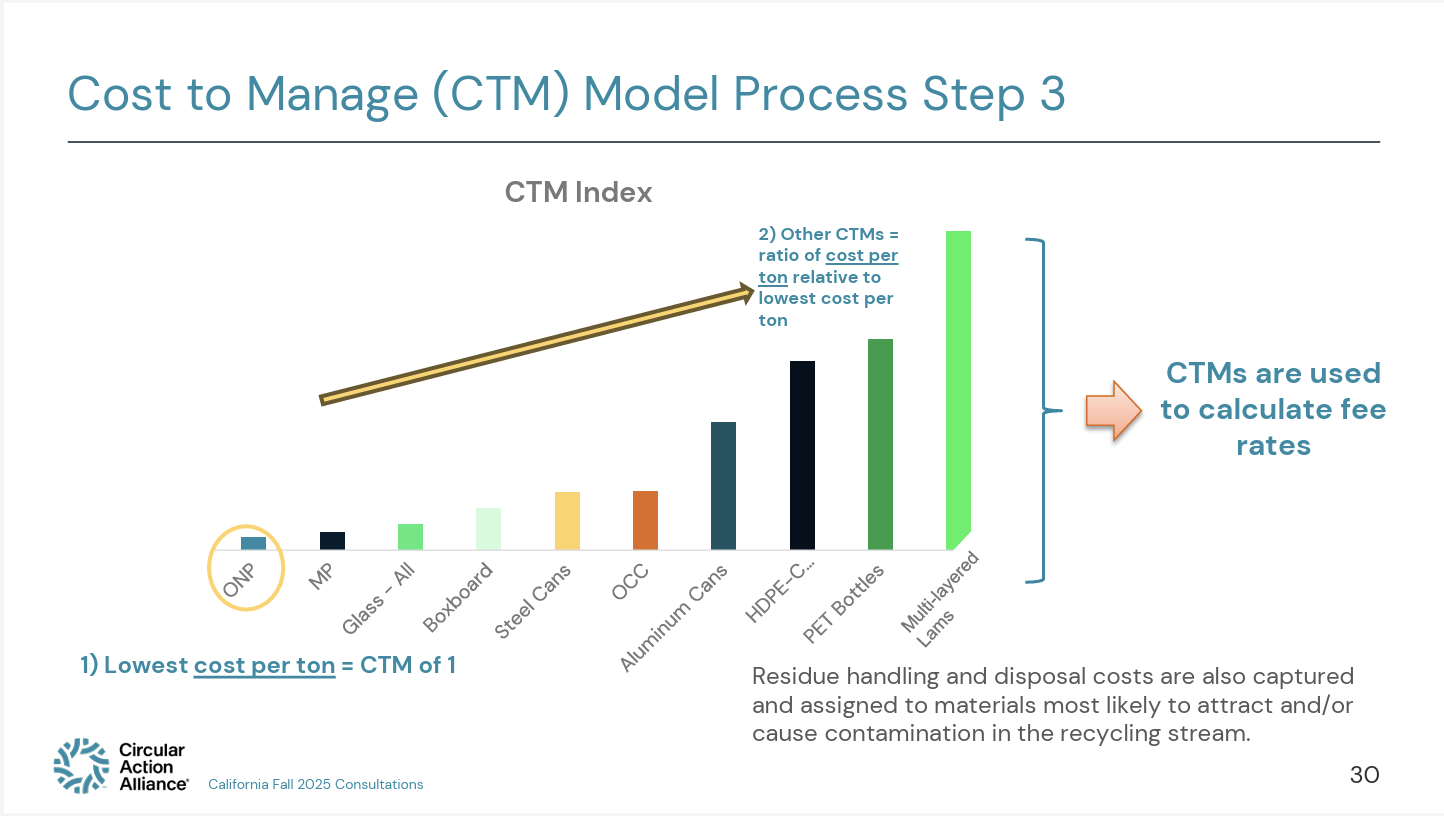
- Based on Costs to Manage, for each material type
- Plastic and Multi-layered laminates have the highest Costs to Manage
Who will pay the fees?
EPR fees apply to brands that had gross sales last year over one million dollars ($1,000,000) in California.
Brands will begin paying SB54 EPR fees starting January 2027 according to Circular Action Alliance.
(References: The full Bill text is here: SB54 Bill. A nice summary is here: Sustainable Packaging Coalition)
How to calculate and budget for EPR Fees?
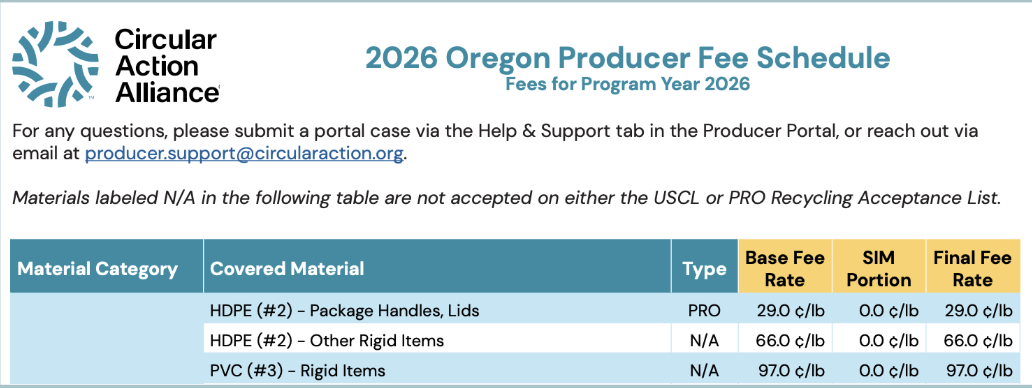
The California EPR Fee Schedule has not been released as of January 2026. However, the Oregon 2026 Fee Schedule is available to the public.
We can use Oregon as a ballpark estimate, and assume that California will be similar. A detailed explanation of the fees is available here: Circular Action Alliance How to Budget Webinar, July 2025
Looking at “HDPE #2 Package Handles, Lids” as an example, a producer will pay $0.29 per pound of HDPE plastic produced. (Source data: Oregon 2026 EPR Fee Schedule)
Estimate your future SB54 costs with our EPR fee calculator
To help brands prepare, we’ve built an EPR Fee Estimate Calculator that allows you to model potential California SB54 costs using Oregon’s published fee data.
The calculator helps you:
- Estimate future EPR fees by material type
- Identify your highest-cost packaging components
- Compare plastics and alternative materials based on fee impact
The calculator is available for brands actively planning their SB54 compliance and budgeting strategies.
(Source: the Oregon 2026 Fee Schedule)
What California brands should do now (as of January 2026)
SB54 compliance planning is already underway. Brands that act early will have more flexibility to adjust materials and budgets before fees go live.
Step 1: Register with the PRO (this is CAA, the Circular Action Alliance ) and get access to the Producer Portal.
Step 2: Submit your brand’s 2025 baseline supply data to CAA. Important Deadline: May 31, 2026 (Source: Packaging Dive). This includes total weight, plastic-only weight, and count of plastic components
Step 3: Do a preliminary Budget Exercise based on your current data, using the Oregon producer fees.
Our EPR Fee Estimate Calculator can support this step by highlighting fee-intensive plastics and helping prioritize packaging changes.
SB54 makes material choices a financial decision
California’s SB54 EPR program fundamentally changes how packaging decisions affect the bottom line. Materials that are difficult to manage at end of life will increasingly carry higher costs, while thoughtful design and material optimization can reduce long-term fee exposure.
Brands that start modeling their EPR fees before California’s final schedule is released will be better positioned to manage risk, control costs, and align packaging strategy with regulatory reality.
Need help planning for SB54?
If you’re unsure how California’s EPR fees will affect your packaging portfolio, we work with brands to model producer costs, identify high-fee materials, and plan practical next steps.
Get in touch to see how we can support your SB54 preparation.
Related Posts

Responsible End Markets (REM): How US EPR laws are reshaping demand for recycled plastic
Across the United States, packaging Extended Producer Responsibility (EPR) laws are evolving rapidly and, with them, a major shift in

How to choose a producer responsibility organization (PRO) in 2026
Raise your hand if you’re a brand that sells consumer packaged goods! 🙋🏽♀️ Depending on where your market is, Extended

UK EPR deadlines 2026: Key dates, reporting rules and compliance risks
If you’re a brand in the UK and you use packaging, the new UK extended producer responsibility (UK EPR) regulations
Design for Recyclability 2026: New material, label & additive restrictions
The 2025 EU PPWR (Packaging Waste Regulation) has ushered in a ‘packaging renaissance’, where packaging is being designed for both

How to build an EPR-ready packaging data architecture for 2026
Extended Producer Responsibility (EPR) laws are expanding rapidly across global markets. For brands, this shift brings a clear reality: packaging

COP30 brand takeaways from Belém: what matters for packaging EPR and plastic recovery
Belém, the host city of COP30, has become a vivid symbol of climate disruption. From extreme heat to deforestation and
California’s SB 54 plastic packaging EPR: November 15 deadline explained and what’s next
California’s SB 54 plastic packaging EPR law is the most ambitious packaging policy in the United States. It requires producers

Extended Producer Responsibility – How Can It Drive Global Circularity and Sustainability?
Extended Producer Responsibility (EPR) is the concept that producers and importers should take responsibility for the products they put into

What is Extended Producer Responsibility (EPR) & How do Plastic Credits Fit In?
What is EPR? Extended Producer Responsibility (EPR) is the concept that brands, plastic packaging producers and importers should take responsibility