


Photo credit: IISD
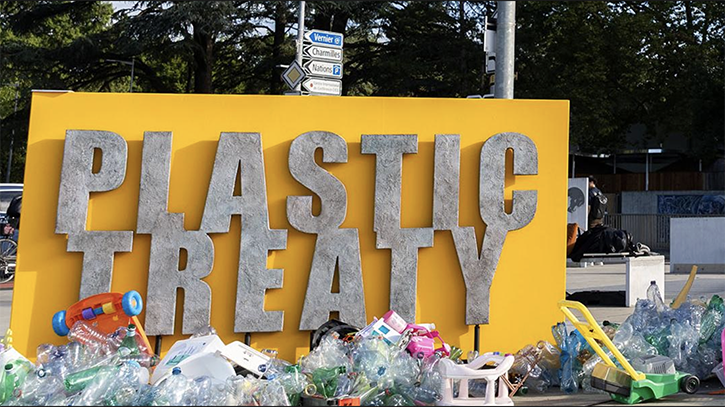
The Global Plastics Treaty is poised to become the most consequential global policy framework shaping packaging compliance and materials strategy for brands and producers. As negotiations continue toward an expected agreement in 2026, companies must understand emerging compliance expectations and future regulatory realities that extend far beyond domestic Extended Producer Responsibility (EPR) schemes.
If you want to understand how your packaging strategy will stand up to emerging global rules:
What Is the Global Plastics Treaty?
In March 2022, the United Nations Environment Assembly adopted Resolution 5/14, mandating negotiations toward a legally binding international agreement to end plastic pollution. The treaty covers the full life cycle of plastics, from production and product design to waste management and environmental leakage (UNEP, 2022).
Negotiations are ongoing through the Intergovernmental Negotiating Committee (INC) process. While consensus on final measures is still evolving, the treaty is expected to address:
- Reduction of problematic and avoidable plastics
- Product design requirements
- Chemicals of concern
- Transparency and reporting
- Financing mechanisms
- Waste management and circular economy systems
Unlike regional rules, this framework aims to create global alignment. That matters for multinational brands managing packaging across multiple jurisdictions.
Why this matters: Packaging compliance and materials
Packaging accounts for a significant share of global plastics production and waste, and regulators are watching closely. Reports from UNEP and WWF highlight that packaging solutions, especially single-use plastics, should be pivotal in global policy frameworks that aim to reduce pollution and advance circularity.
A global treaty will matter for brands because concurrent national and regional regulations (e.g., EU’s Packaging & Packaging Waste Regulation) are already imposing stringent requirements on recycled content, design for recyclability, and transparency.
Even absent a finalized treaty text, the direction is clear: the global policy environment is shifting toward greater accountability for packaging performance, information disclosure, and responsible material selection.
How it works and what brands should do now
Here’s what companies should anticipate and act on to prepare packaging strategies aligned with treaty momentum:
1. Design for compliance across borders
Future treaty commitments are expected to incentivize or require:
- Design for recyclability
- Minimum recycled content standards
- Reduction of problematic single-use plastics
Brands must audit packaging portfolios now and prioritize circular design principles rather than last-minute redesigns.
2. Prepare for material transparency and reporting
Transparency requirements are likely to expand globally. This means:
- Documenting material composition
- Tracking recycled content and sources
- Preparing supply chains for standardized disclosures
Governments and trading partners increasingly demand robust data. Start building material and waste tracking systems early to avoid last-minute compliance shortfalls.
3. Integrate EPR and lifecycle strategies
Even before any treaty is ratified, Extended Producer Responsibility (EPR) frameworks are proliferating in Europe, the U.S., and elsewhere. Organizations must align treaty readiness with these schemes to avoid fragmented compliance.
4. Engage in policy dialogue
Proactive engagement with policy platforms, industry coalitions, and stakeholder networks can help shape implementation priorities and ensure business interests are represented in evolving standards.

Risks and cautions for packaging leaders
Risk of fragmented implementation:
Even if the treaty is adopted in 2026, its transformation into enforceable national law may lag, creating asynchronous requirements across jurisdictions. Brands should guard against regulatory fragmentation that could inflate compliance costs and complexity.
Don’t over-commit to trends:
Beware of substituting plastics with alternatives that lack verified environmental benefits. No material is inherently compliant unless evaluated in terms of lifecycle impacts and recyclability.
Focus on data, not buzzwords:
Regulators are moving toward measurable benchmarks (e.g., recycled content %, traceability metrics, reporting obligations). Treat reporting systems and data integrity as core compliance infrastructure, not optional greenwashing tools.
The global plastics treaty is not a distant policy discussion. It is a structural shift in how packaging will be evaluated, financed and regulated worldwide.
Brands that treat this as a compliance burden will struggle. Those that treat it as a design and systems opportunity will be better positioned for market access, investor confidence and long-term resilience.
If you want clarity on how the global plastics treaty could affect your packaging materials, compliance exposure or recovery strategy, contact our team to start the conversation.
FAQs
How will the global plastics treaty affect packaging compliance worldwide?
The treaty’s provisions are expected to accelerate harmonized design, transparency, and lifecycle requirements for packaging. Brands will likely need greater reporting, recyclability, and accountability standards to enter global markets.
What packaging materials will be impacted by the global plastics treaty?
Materials such as single-use plastics, low-value polymers, and difficult-to-recycle packaging are prioritized for reduction or redesign. Material transparency and recyclability criteria will influence which materials are viable long-term.
Does the global plastics treaty mean new requirements for recycled content in packaging?
While treaty text is not final, discussions and existing regulatory trends point toward mandatory recycled content standards as a global compliance benchmark.
The Global Plastics Treaty is shaping a new era in packaging compliance and materials strategy. Forward-looking brands are already aligning design, reporting, and material selection with evolving global regulatory trends. Those that delay risk fragmented compliance costs and market barriers.